Multi-View Dynamic Fusion for Next Activity Prediction in Business Processes Testing
Abstract
To address issues in the next activity prediction task of predictive business process monitoring—namely the over-reliance on a single control-flow perspective, the underutilization of extended attributes, and the inability of static feature fusion strategies to adapt to diverse process scenarios—this paper proposes a Multi-View Dynamic Fusion method for Next Activity Prediction in Business Processes (MVDF-NAP).
This method constructs event representations from three core perspectives: control-flow, time, and resource. Extended attributes beyond these core perspectives are encoded into a global context vector and injected as prefixes into the sequence modeling process. Building upon this, a dynamic fusion module based on cross-view attention is designed, enabling the model to adaptively learn and allocate fusion weights for each perspective. By combining this with a Transformer architecture to capture long-range dependencies, the method ultimately realizes next activity prediction.
Experiments were conducted on 8 publicly available real-world event log datasets. The results demonstrate that MVDF-NAP achieves the highest prediction accuracy on 6 of the datasets, reaching 96.76% and 88.50% on the Helpdesk and RTFM datasets, respectively. Furthermore, the proposed method can adaptively adjust the importance of the control-flow, time, and resource perspectives according to different business process scenarios, thereby achieving a balance between predictive performance and model interpretability.
Method
我们的框架(MVDF-NAP)主要由四个阶段组成:多视角特征提取、前缀信息编码、特征动态融合和下一活动预测。
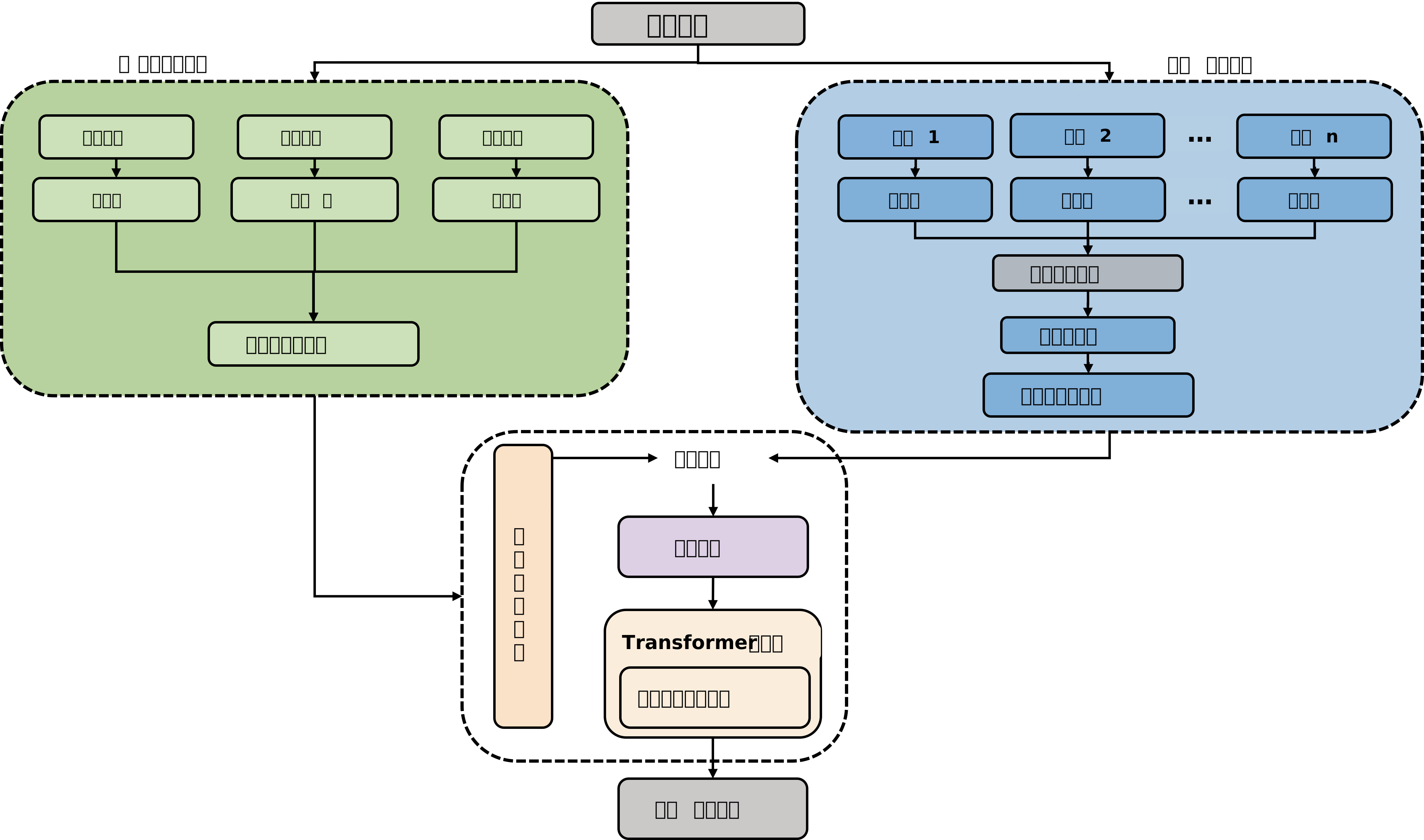
四个阶段如下:
- 多视角特征提取: 摒弃单一视角,从事件日志中提取控制流、时间和资源三类普遍存在的属性信息,将其转化为具有语义信息的连续向量。
- 前缀信息编码: 将独立于核心三视角的扩展数据属性编码为一个全局上下文向量,为序列提供宏观的业务环境约束,避免直接拼接带来的信息冗余。
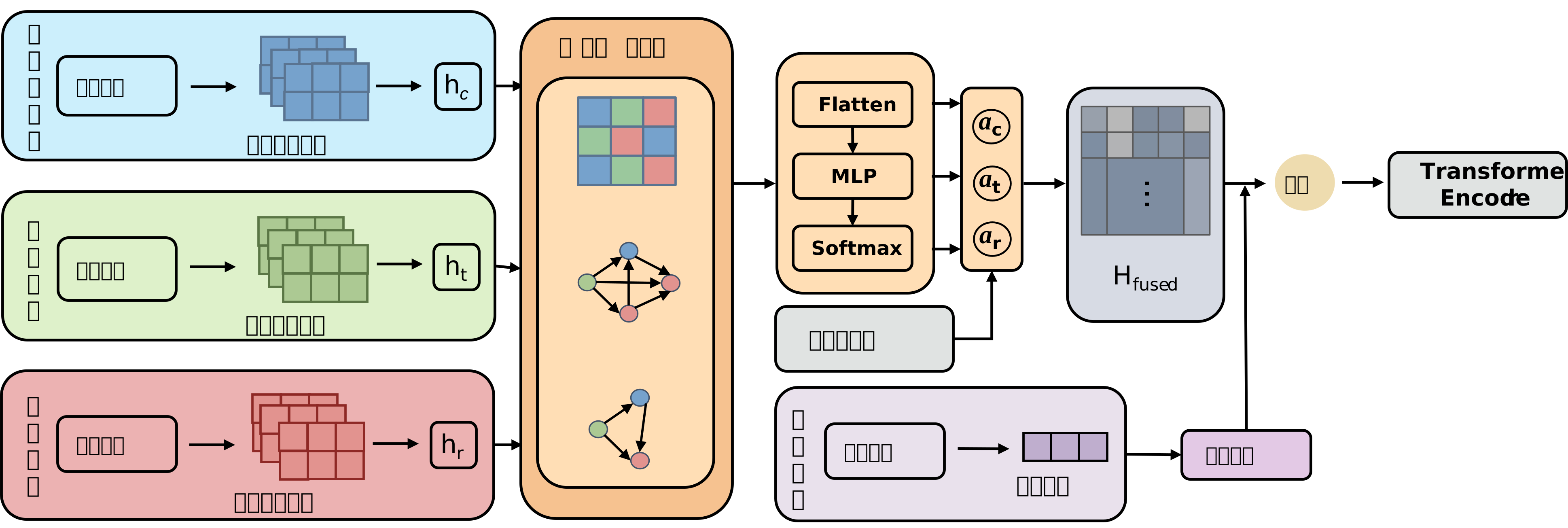
- 特征动态融合: 引入跨视角注意力机制,结合当前流程实例的上下文,自适应判断控制流、时间和资源三者之间的互补关系,生成动态加权融合的序列特征。
- 下一活动预测: 将融合后的事件序列与前缀序列拼接,共同输入 Transformer 编码器捕捉全局依赖,生成最终的下一事件预测结果。
特征动态融合
我们设计了三种核心视角和一种前缀编码机制,以全面捕捉真实业务流程的多维语义特征。
Results
我们在涵盖IT服务、金融等领域的8个公开事件日志数据集上进行了实验,并与包含传统序列模型和图神经网络在内的5种代表性基线模型进行了对比。
| Model | BPIC2012_A | BPIC2012_O | BPIC2013_I | BPIC2013_P | BPIC2017_O | BPIC2020 | Helpdesk | RTFM |
|---|---|---|---|---|---|---|---|---|
| LSTM | 72.07% | 75.98% | 66.5% | 52.9% | 80.4% | 85.6% | 74.33% | 75.25% |
| PTM | 76.7% | 78.6% | 65% | 51.8% | 81.8% | 85.5% | 78.6% | 81.73% |
| MiDA | 79.5% | 84.2% | 72.4% | 62.1% | 89.4% | 88.2% | 80.1% | 84.64% |
| MiTFM | 80% | 84.3% | 72.4% | 63.5% | 90.3% | 88.7% | 82% | 81.24% |
| MHG | 74.25% | 83.3% | 72.85% | 64.9% | 92.3% | 85% | 83.5% | 81.89% |
| MVDF-NAP | 80.41% | 84.62% | 74.59% | 64.89% | 90.51% | 89.05% | 96.76% | 88.5% |
可解释性分析
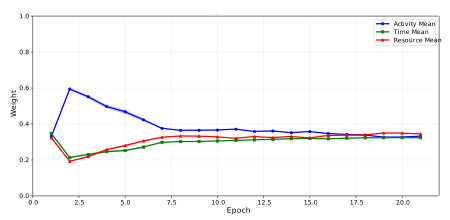
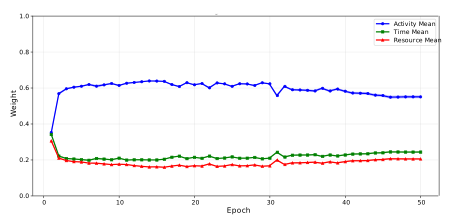
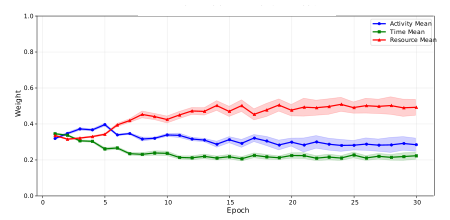
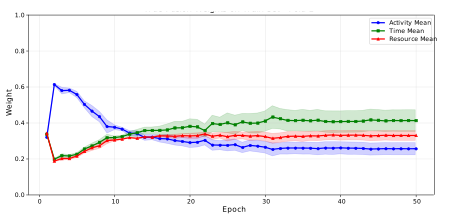
为了揭示动态融合机制的工作原理,我们提取了模型在训练过程中控制流 (Activity)、时间 (Time) 和 资源 (Resource) 三个视角融合权重的演化轨迹。所有模型均从 1:1:1 的权重初始化开始。 通过对 8 个数据集的对比分析,我们发现不同业务流程对多视角信息的依赖程度存在显著差异,并成功将其划分为以下四种典型模式:
1. 控制流主导型 (Control-Flow Dominated)
代表数据集:BPIC2020, Helpdesk
控制流视角在训练初期迅速上升并保持高位。以 Helpdesk 为例,主流程路径占比较高,模型仅通过活动序列便能捕捉大部分转移规律,无需过度依赖其他视角。
2. 资源主导型 (Resource Dominated)
代表数据集:BPIC2012, BPIC2013_I, BPIC2013_P
资源视角权重在训练后期反超并成为主要驱动力。在信息技术事件处理等流程中,控制流循环较多,下一步操作高度依赖于当前工程师(资源)的专业领域和权限。
3. 时间主导型 (Time Dominated)
代表数据集:BPIC2012_A
训练深入后,时间视角(绿线)逐渐超越控制流。在这类具有复杂分支和循环的流程中,相同活动前缀的不同处理阶段往往需要依赖全局/局部时间间隔来进行区分。
4. 多视角平衡型 (Multi-View Balanced)
代表数据集:BPIC2017_O, RTFM
三类视角的权重在后期逐渐趋于平衡(~0.33)。这类流程高度复杂且标准化,单一视角难以完全主导预测,控制流、时间和资源之间展现出极强的互补关系。